
Acupuncture & the Nervous System
Does Acupuncture Really Influence Our Nervous System?
Acupuncture has been practiced for thousands of years, but our understanding of how it works continues to evolve.
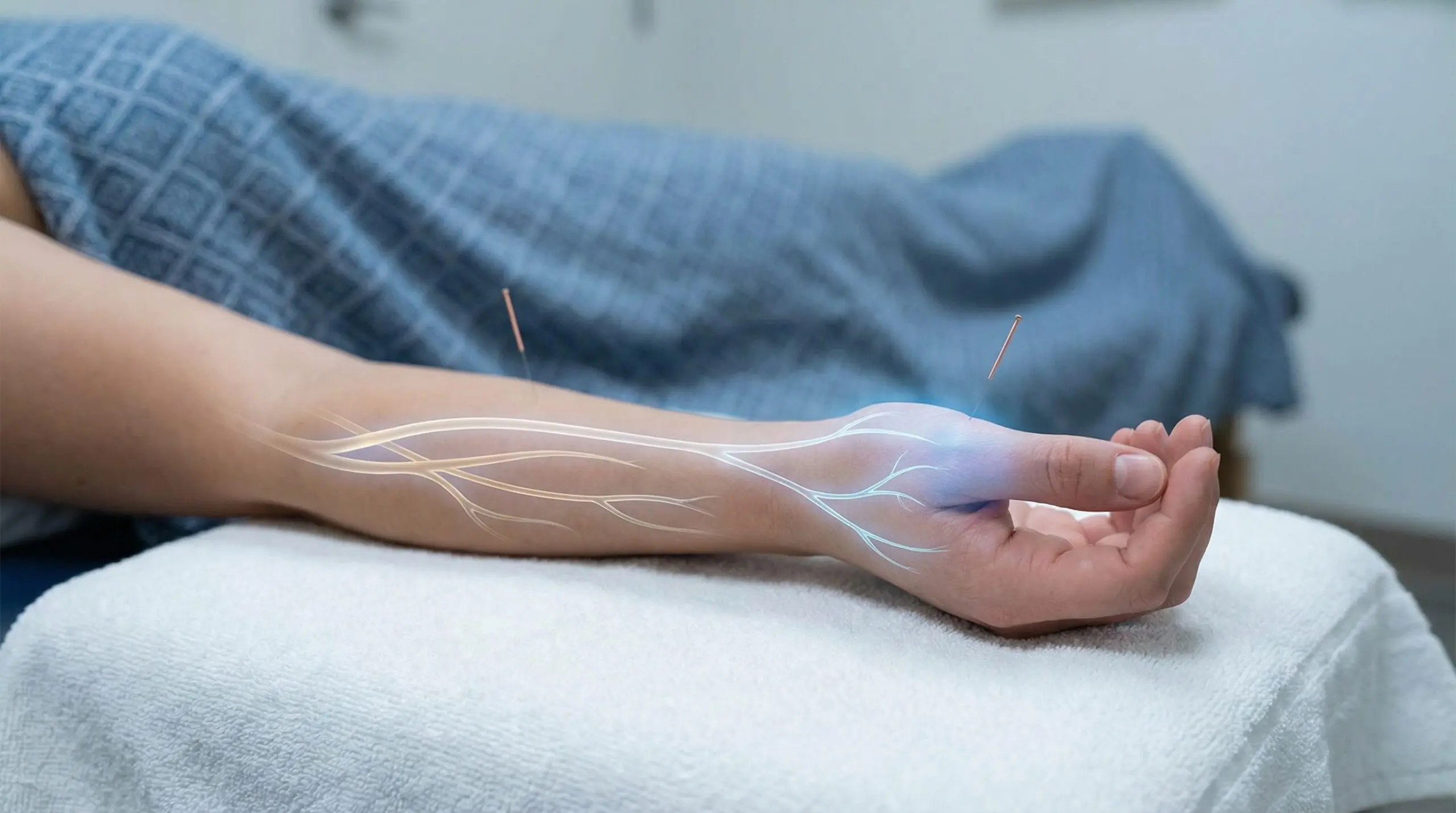
Today, we’re able to verify its effects not only through traditional clinical practice, but also through neuroimaging and modern clinical research. Increasingly, acupuncture is understood as a method of influencing the nervous system — making it an ideal treatment for stress regulation, sleep concerns, stress related digestion, and emotional balancing.

Drew has 25 years of clinical experience treating fertility and pregnancy-related conditions, and has spent 18 years training acupuncturists and other healthcare practitioners across Ontario in Traditional Chinese Medicine techniques — including Naturopathic Doctors & Medical Doctors.
Stress and the Nervous System
Chronic stress shifts the autonomic nervous system toward sympathetic dominance — what most people know as the “fight or flight” response. When this system is activated, your heart beats faster, breathing becomes shallow, muscles tighten, digestion slows, and sleep becomes lighter and more fragmented.
This response is helpful in short bursts. It’s designed to help you react quickly in a crisis. The problem is that for many people, this setting gets stuck in the “on” position.
An analogy I often use is this: imagine your nervous system has a gas pedal and a brake. Chronic stress keeps the gas pedal partially pressed down all day long. Even when you’re lying in bed at night, your system hasn’t fully taken its foot off the pedal.
That’s when people begin to notice symptoms like:
- Racing thoughts when trying to fall asleep
- Waking at 3 a.m. with a surge of alertness
- Palpitations that feel out of proportion to the moment
- Tight shoulders and jaw
- Digestive changes during busy or emotional periods
One measurable indicator of this imbalance is heart rate variability (HRV), which reflects how flexibly the nervous system can shift between activation and recovery. Reduced HRV is commonly observed in individuals experiencing chronic stress and anxiety patterns. Recent meta-analyses show that acupuncture can increase parasympathetic activity and improve HRV compared with sham treatment, suggesting a direct influence on autonomic balance (Hamvas et al., 2023; Ma et al., 2025). Check out more information on HRV here.
In practical terms, this means acupuncture may help the nervous system relearn how to press the brake.
And when that happens, physical symptoms often begin to soften.
What Happens During Treatment
Acupuncture works through several overlapping mechanisms, and understanding them helps remove some of the mystery.
Autonomic Modulation
Research shows that acupuncture can increase parasympathetic tone — the branch of the nervous system responsible for rest, digestion, and recovery. During treatment, many patients notice their breathing naturally slows, their shoulders drop, and their mind feels quieter.
This isn’t sedation. It’s regulation.
If stress is like having your internal alarm system set too sensitively, acupuncture may help recalibrate that alarm so it doesn’t trigger as easily.
Brain Network Regulation
Functional MRI research demonstrates that acupuncture influences brain regions involved in emotional processing and stress regulation. A 2024 neuroimaging study examining individuals with insomnia found that acupuncture altered connectivity within emotional brain networks, and these changes correlated with improvements in sleep and anxiety symptoms (Jiang et al., 2024).
If you’ve experienced anxiety, you likely already understand the sleep–anxiety cycle: the worse your sleep becomes, the more reactive your anxiety feels. And the more anxious you feel, the harder it becomes to sleep. This creates a reinforcing loop.
One of my first recommendations for individuals with anxiety is always a careful examination of sleep habits, because improving sleep often lowers the overall volume of anxiety.
Acupuncture appears to influence both sides of that loop.
Neurochemical and Hormonal Effects
Emerging research also suggests acupuncture interacts with stress-related neurochemical systems and the hypothalamic–pituitary–adrenal (HPA) axis — one of the body’s central stress regulators (Journal of Integrative Medicine, 2024).
To put that simply: acupuncture may help shift how your body releases and responds to stress hormones.
Think of it less as “forcing relaxation” and more as helping your system reset its sensitivity.
These mechanisms are layered. Acupuncture does not act on one pathway alone — it influences peripheral nerves, spinal gating systems (relevant for pain and muscle tension), brainstem centres, and higher emotional networks at the same time.
It is less like flipping a switch and more like gently tuning an instrument.
Sleep and Digestive Regulation
Because the autonomic nervous system governs sleep cycles and digestive function, improvements in regulation often ripple outward.
Clinical studies suggest acupuncture may improve sleep quality and reduce insomnia symptoms through autonomic and neural modulation (Jiang et al., 2024). In practice, patients frequently report that they:
- Fall asleep more easily (especially the night of their acupuncture treatments)
- Wake less frequently
- Feel more restored in the morning
Digestive symptoms tied to stress — bloating, irregular bowel patterns, functional discomfort — are also closely linked to nervous system activation. When the body is in fight-or-flight mode, digestion becomes secondary. When parasympathetic tone improves, digestion often becomes more coordinated and predictable.
Many patients are surprised that when their stress settles, their digestion follows.
A Modern Perspective on an Established Therapy
While acupuncture has historical roots in traditional Chinese medicine (TCM), modern research increasingly provides measurable explanations for its effects. Studies examining vagal function and HRV coherence suggest acupuncture may support vagus nerve activity and autonomic stabilization in individuals with anxiety disorders (Valle et al., 2024).
This growing body of research helps frame acupuncture not as an alternative belief system, but as a neurophysiological intervention capable of influencing stress circuitry in observable ways.
Integration, Not Replacement
Acupuncture is not presented as a replacement for conventional medical or psychological care. Rather, it can serve as a complementary therapy aimed at improving nervous system resilience.
For individuals experiencing chronic stress, anxiety, insomnia, or digestive disruption, acupuncture offers a structured way to help the body shift out of persistent activation and toward regulation.
The goal is not simply relaxation.
The goal is adaptability.
Over time, repeated treatments may help the nervous system relearn flexibility — improving sleep, stabilizing mood, easing physical tension, and supporting recovery.
And for many patients, that shift feels less like dramatic change and more like something quietly returning to normal.
Getting Help With Drew
If your nervous system has been in overdrive for some time, that does not mean this is your permanent state. Adaptability can be rebuilt. If you’re experiencing ongoing stress, anxiety, insomnia, or stress-related digestive symptoms, I encourage you to book an appointment.
Together, we can evaluate how your system is functioning and create a structured plan to help it regain flexibility and resilience.
References
Hamvas, S. Z., et al. (2023). Effects of acupuncture on autonomic nervous system: A systematic review and meta-analysis. Complementary Therapies in Medicine.
Jiang, T. F., et al. (2024). Acupuncture modulates resting-state functional connectivity in insomnia: A randomized controlled neuroimaging study. BMC Complementary Medicine and Therapies.
Ma, Y. Z., et al. (2025). Clinical efficacy and safety of acupuncture in modulating autonomic nervous function: Meta-analysis of randomized trials. Frontiers in Neuroscience.
Valle, S. S. M., et al. (2024). Acupuncture, HRV coherence, and anxiety symptoms: A clinical case series. Medical Acupuncture.
Journal of Integrative Medicine (2024). Acupuncture and regulation of the hypothalamic–pituitary–adrenal axis.