
Comparing the Two Types of Non-Invasive Vagus Nerve Stimulation (VNS)
The vagus nerve is one of the main communication highways between your brain and your body.
It plays a key role in regulating heart rate, digestion, inflammation, mood, and your stress response. When your nervous system is stuck in “fight or flight,” the vagus nerve helps guide it back toward a calmer, more restorative state.
Two Types of VNS
You may have heard of different ways that you can “stimulate” your vagus nerve at home – a very popular concept in the wellness industry. Although it may be possible that moving your eyes in a particular direction, humming and laughter may “stimulate” your vagus nerve – the kind of stimulation that is performed in the majority of research is with actual electrical stimulation. Commonly referred to as “non-invasive vagus nerve stimulation (VNS)”. We say non-invasive in comparison to more invasive VNS which typically involves the surgical implantation of a device in the body.
There are two types of this non-invasive type of stimulation
1. Transauricular VNS (in the ear) and
2. Transcutaneous VNS
1. Ear-Based VNS (Transauricular VNS)
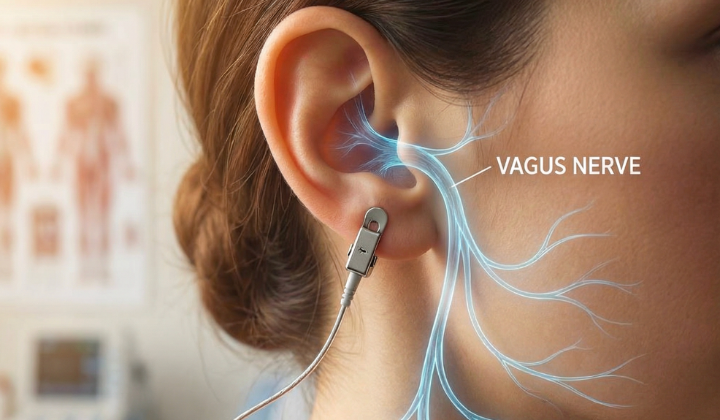
This method uses small clips placed on specific areas of the outer ear which are then stimulated with a device similar to a TENS unit at a specific type of frequency. When placed in the ear properly, these areas can stimulate a small branch of the vagus nerve.
This is the type of VNS stimulation that I use in my clinical practice.
Because this branch sends signals directly to calming centres in the brainstem, gentle electrical stimulation at the ear can help:
- Increase parasympathetic (“rest and digest”) activity
- Reduce stress reactivity
- Support better sleep
- Improve emotional regulation
Most people describe the sensation as a mild tingling. It isn’t painful, and treatments are typically quite relaxing.
This is the form most commonly used for stress, anxiety, and insomnia support.
It’s also interesting to note that Traditional Chinese medicine has been performing acupuncture in the ears for centuries – with many of these points being indicated for “calming the mind”.
2. Neck-Based VNS (Cervical VNS)
This approach stimulates the vagus nerve through the skin on the side of the neck.
A hand-held electrical device is used where the user places the unit along the vagus nerve on the neck and stimulates it manually.
It works through a similar pathway — sending signals to the same brain regions involved in stress regulation. It is often used in research settings for conditions like PTSD or migraine and can influence how the body responds to acute stress.
The sensation generally feels slightly stronger than ear stimulation but is still considered non-invasive.
Are They Similar?
Both approaches ultimately influence the same calming brain circuits. Research suggests they can:
- Improve heart rate variability (a marker of nervous system flexibility)
- Reduce sympathetic over-activation
- Support emotional and sleep regulation
The difference is mainly where the stimulation is applied — the ear or the neck. For stress, anxiety, and insomnia care, ear-based stimulation is often preferred because it is:
- More comfortable
- Easy to administer
- Well studied in sleep and anxiety research
- Suitable for repeated sessions
What Does This Mean for You?
If you feel wired, tense, easily overwhelmed, or unable to fully relax — your nervous system may be spending too much time in activation mode.
Non-invasive VNS is designed to gently nudge your system toward recovery. It does not “force” relaxation. Instead, it helps improve your nervous system’s ability to shift gears — something called adaptability.
Many people notice:
- A sense of settling or quieting internally
- Improved sleep onset
- Less physical tension
- Better stress resilience over time
Like acupuncture, it works best as part of a broader regulation strategy rather than as a standalone fix.
Think of It This Way…
Think of your nervous system like a car engine.
If the accelerator is stuck down (fight-or-flight), the engine keeps revving. Vagus nerve stimulation acts like restoring access to the brake pedal — helping you slow down when needed.