
Acupuncture for Insomnia in Toronto: Understanding Sleep, Stress, and the Path Back to Rest
Sleep isn’t passive…not exactly.
If you’re lying awake at 3 a.m. — mind racing, body exhausted but stubbornly alert — you already know that insomnia is more than just “a bad night.”
It’s a pattern.
And like most patterns that involve sleep, it’s deeply connected to how your nervous system is functioning.

 alt="Drew Nesbitt, R.TCMP, R.Ac.">
Drew has 25 years of clinical experience treating fertility and pregnancy-related conditions, and has spent 18 years training acupuncturists and other healthcare practitioners across Ontario in Traditional Chinese Medicine techniques — including Naturopathic Doctors & Medical Doctors.
Acupuncture for insomnia is one of the most researched areas in Traditional Chinese Medicine, with a growing body of clinical evidence supporting its use as an effective, drug-free approach to restoring sleep. If you’re in Toronto and looking for a natural path back to consistent, restorative rest, this article will walk you through what insomnia actually is, why it happens, and what the research tells us about acupuncture as a treatment option.
What is Insomnia – Really?
Sleep isn’t passive. It’s one of the most active and restorative processes the body performs. During sleep, the brain consolidates memory, hormones reset, muscles recover, and the nervous system recalibrates. When that process becomes disrupted, the effects ripple through everything.
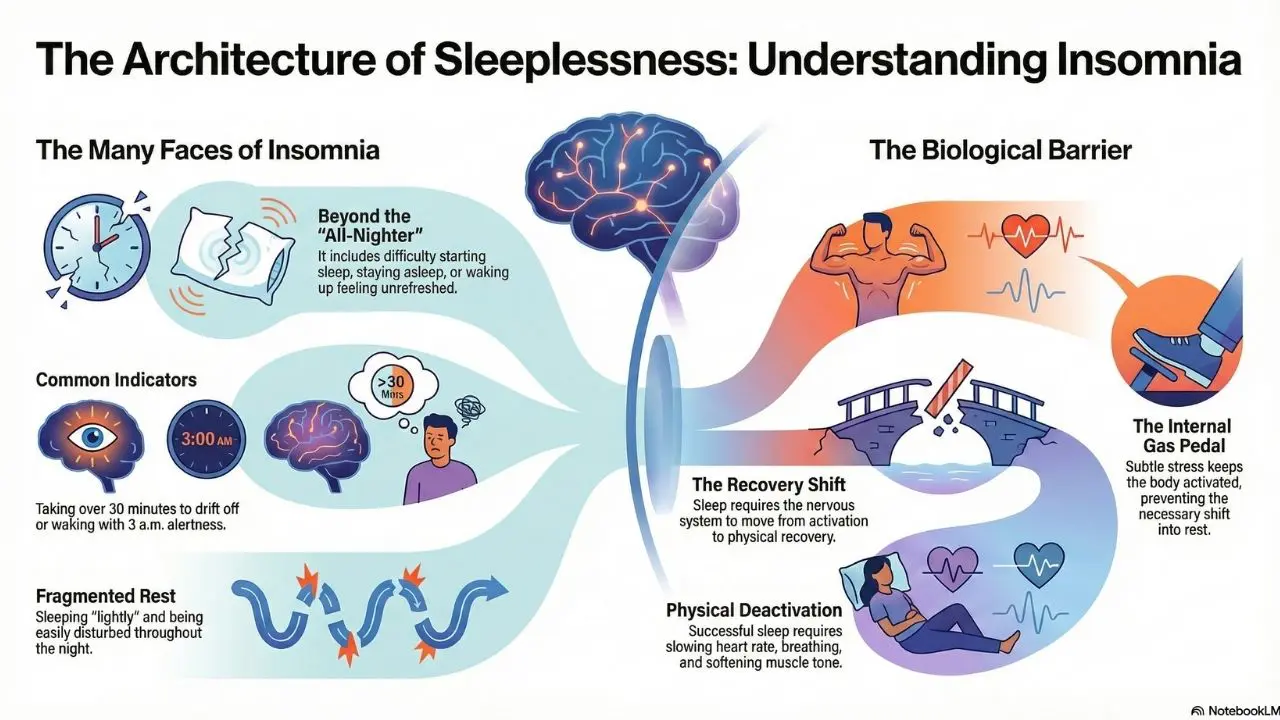
Insomnia refers to difficulty initiating or maintaining sleep, or waking earlier than intended and being unable to fall back asleep. It also includes waking feeling unrefreshed — even after adequate time in bed.
Many people assume insomnia means lying awake all night. More commonly, it looks like:
- Taking more than 30 minutes to fall asleep
- Waking multiple times during the night
- Waking at 3–4 a.m. with a surge of alertness
- Sleeping lightly and being easily disturbed
- Waking feeling as though you barely slept
For some, the issue is falling asleep. For others, it’s staying asleep. For many, it’s both.
Why Sleep Becomes Difficult: The Nervous System Connection
Sleep requires a shift. The nervous system must move from activation to recovery — breathing slows, heart rate decreases, muscle tone softens, and stress hormones decline.
When the body remains partially activated — even subtly — that shift becomes harder to make. Chronic stress is like having your internal gas pedal slightly pressed at all times. Insomnia is often the result.
Difficulty Falling Asleep When falling asleep is the primary issue, it’s often related to cognitive and physiological activation. The mind continues reviewing the day or anticipating tomorrow. The body may feel “tired but wired” — a state many people with stress-related insomnia recognise immediately.
Frequent Waking Waking throughout the night often reflects light, fragmented sleep architecture. Even small fluctuations in stress hormones or blood sugar can trigger partial awakenings. The body never fully settles.
Early Morning Waking Waking earlier than desired — particularly between 3 and 5 a.m. — is common in individuals under prolonged stress. Cortisol naturally begins rising in the early morning hours, and in stress-sensitive systems, that rise can feel exaggerated and jarring.
Not Feeling Rested Upon Waking Sometimes the issue isn’t duration but quality. You may sleep through the night but wake feeling heavy, foggy, or unrefreshed. This often reflects disrupted sleep architecture — where deeper, restorative stages of sleep are reduced or shortened.
The Insomnia–Anxiety Loop
One of the most frustrating aspects of insomnia is how quickly it becomes self-reinforcing. After several poor nights, you may begin worrying about sleep itself. You might notice yourself watching the clock, feeling tense at bedtime, anticipating another difficult night, or planning the next day around expected exhaustion.
Sleep begins to feel like something you must achieve. That effort alone can keep the nervous system partially activated — making sleep even harder to reach.
Over time, evenings stop feeling like wind-down periods and start feeling like performance evaluations. This loop is well recognised in sleep medicine and is one of the reasons why insomnia can persist long after the original stressor has resolved.
Long-Term Effects of Chronic Insomnia
When sleep disruption persists, the effects extend well beyond tiredness. Chronic insomnia has been associated with:
- Increased anxiety sensitivity
- Mood instability and reduced emotional resilience
- Reduced stress tolerance
- Digestive irregularities
- Heightened pain perception
- Lower heart rate variability — a marker of reduced nervous system flexibility
Even subtle sleep deprivation reduces emotional resilience. Small stressors feel larger. Patience shortens. Recovery from everyday demands takes longer.
Importantly, insomnia rarely has a single cause. It typically reflects a combination of stress physiology, nervous system conditioning, and disrupted sleep routine patterns — all of which can be addressed with the right approach.
What Does the Research Say About Acupuncture for Insomnia?
The evidence base for acupuncture in treating insomnia has grown substantially in recent years. Here is what the most current research shows:
Acupuncture vs. Sleep Medication A comprehensive systematic review and meta-analysis published in Frontiers in Neurology in 2025, which analysed 25 randomised controlled trials conducted between 2014 and 2024, compared the efficacy and safety of acupuncture against sedative-hypnotic medications for insomnia. The review found that acupuncture produced significant improvements in Pittsburgh Sleep Quality Index (PSQI) scores — a validated measure of sleep quality — and demonstrated a favourable safety profile compared to pharmaceutical sleep aids, which carry risks of dependency, daytime drowsiness, and cognitive effects with prolonged use.
How Acupuncture Influences Sleep at a Neurological Level A 2024 NIH-published review synthesised the neurological mechanisms through which acupuncture supports sleep. The research found that acupuncture influences sleep by regulating central neurotransmitters — including serotonin (5-HT) and gamma-aminobutyric acid (GABA) — both of which play a direct role in sleep onset and maintenance. Acupuncture was shown to upregulate serum GABA and 5-HT levels in individuals with insomnia, supporting the transition into and maintenance of deeper sleep stages.
Acupuncture for Insomnia with Anxiety and Emotional Disturbance A 2023 randomised controlled trial published in Frontiers in Neurology, conducted at West China Hospital, Sichuan University, examined acupuncture in patients with insomnia complicated by anxiety and emotional disturbance. The trial found that acupuncture produced measurable improvements in both sleep quality and anxiety levels compared to sham acupuncture controls — supporting the clinical observation that treating the nervous system as a whole yields better outcomes than targeting sleep in isolation.
Consistency of Treatment Matters Two systematic reviews — Xu (2024) and Zhao (2022) — both found that the effectiveness of acupuncture for insomnia is related to the number of treatment sessions and the duration of the intervention. A committed course of acupuncture produces better and more lasting results than a one-off treatment. Meaningful improvement in sleep typically requires a structured plan over several weeks.
Why Acupuncture Works for Insomnia: A Clinical Perspective
From a Traditional Chinese Medicine perspective, insomnia is rarely viewed as a standalone condition. It is understood as a reflection of imbalance — most commonly involving the Heart, Liver, and Kidney organ systems, which govern emotional regulation, stress response, and the body’s ability to settle at night.
From a contemporary neuroscience perspective, acupuncture is understood to work by:
- Regulating the autonomic nervous system — shifting the body from sympathetic (fight-or-flight) dominance toward parasympathetic (rest-and-digest) activity
- Modulating the HPA axis — the hypothalamic-pituitary-adrenal axis that governs cortisol output and the stress response
- Influencing sleep-related neurotransmitters including serotonin, GABA, and melatonin precursors
- Reducing the physiological hyperarousal that keeps the nervous system partially activated at night
These mechanisms align closely with what’s needed to break the insomnia-anxiety loop — not forcing sleep, but creating the neurological conditions in which sleep can occur naturally.
What to Expect from Acupuncture Treatment for Insomnia in Toronto
At my clinic on the Danforth, the approach to insomnia begins with a thorough assessment. Sleep disruption is never one-size-fits-all. The pattern of your insomnia — whether it’s difficulty falling asleep, frequent waking, early morning alertness, or unrefreshed sleep — points to different underlying dynamics that guide treatment.
Treatment typically involves:
- Acupuncture — targeting points associated with nervous system regulation, stress reduction, and sleep support
- Vagus nerve stimulation (taVNS) — a no-needle option that uses transcutaneous auricular stimulation to influence the vagus nerve and support parasympathetic tone
- TCM herbal medicine — where appropriate, classical formulas to nourish and regulate the systems involved in sleep
- Nutritional and lifestyle guidance — addressing blood sugar stability, cortisol rhythm, and evening wind-down practices
Most patients begin noticing shifts in sleep quality within the first 3 to 4 weeks of consistent treatment. The goal is not just better sleep in the short term, but a more regulated nervous system that supports restful sleep as a baseline state.
What to Expect from Acupuncture Treatment for Insomnia in Toronto
Sleep is not a switch that flips off. It’s a process the body enters when conditions feel safe enough to do so.
The encouraging part is that sleep patterns can change. The nervous system is adaptable. When it receives consistent signals of regulation — through targeted treatment, stable routines, and reduced physiological load — sleep often begins to deepen naturally.
You do not need perfect conditions to sleep well. You need enough nervous system regulation.
Rest is not a luxury. It’s a biological requirement. And for most people, it is entirely recoverable.
Book With Drew
If disrupted sleep has been affecting your mood, focus, energy, or overall wellbeing, I’d encourage you to book an appointment at my Toronto Danforth clinic. Together, we can assess what’s maintaining the pattern and develop a structured plan to help restore deep, consistent sleep.
Get the FREE Stress Guide
Learn about nervous system hacks you can use at home to reduce your uncomfortable symptoms of high stress. Free for everyone to use.