
Understanding Stress: When the Body Stays in “On” Mode
Stress is not inherently harmful. In fact, it’s necessary.
It helps us meet deadlines, respond to emergencies, and navigate challenges. The stress response is designed to be short-lived and adaptive.
The problem arises when stress stops being temporary and begins to feel constant.
Many people no longer recognize stress as a distinct state — it becomes their normal.

What Is Stress, Really?
Stress is a full-body response.
When the brain perceives a threat (physical, emotional, or even imagined), it activates the autonomic nervous system. Heart rate increases. Breathing becomes faster. Muscles tighten. Digestion slows. Stress hormones such as cortisol are released.
This is helpful if you need to react quickly.
It becomes problematic when this response stays activated long after the immediate demand has passed.
Think of it like leaving your car engine idling all day. Eventually, wear and tear begin to show.
Common Symptoms of Ongoing Stress
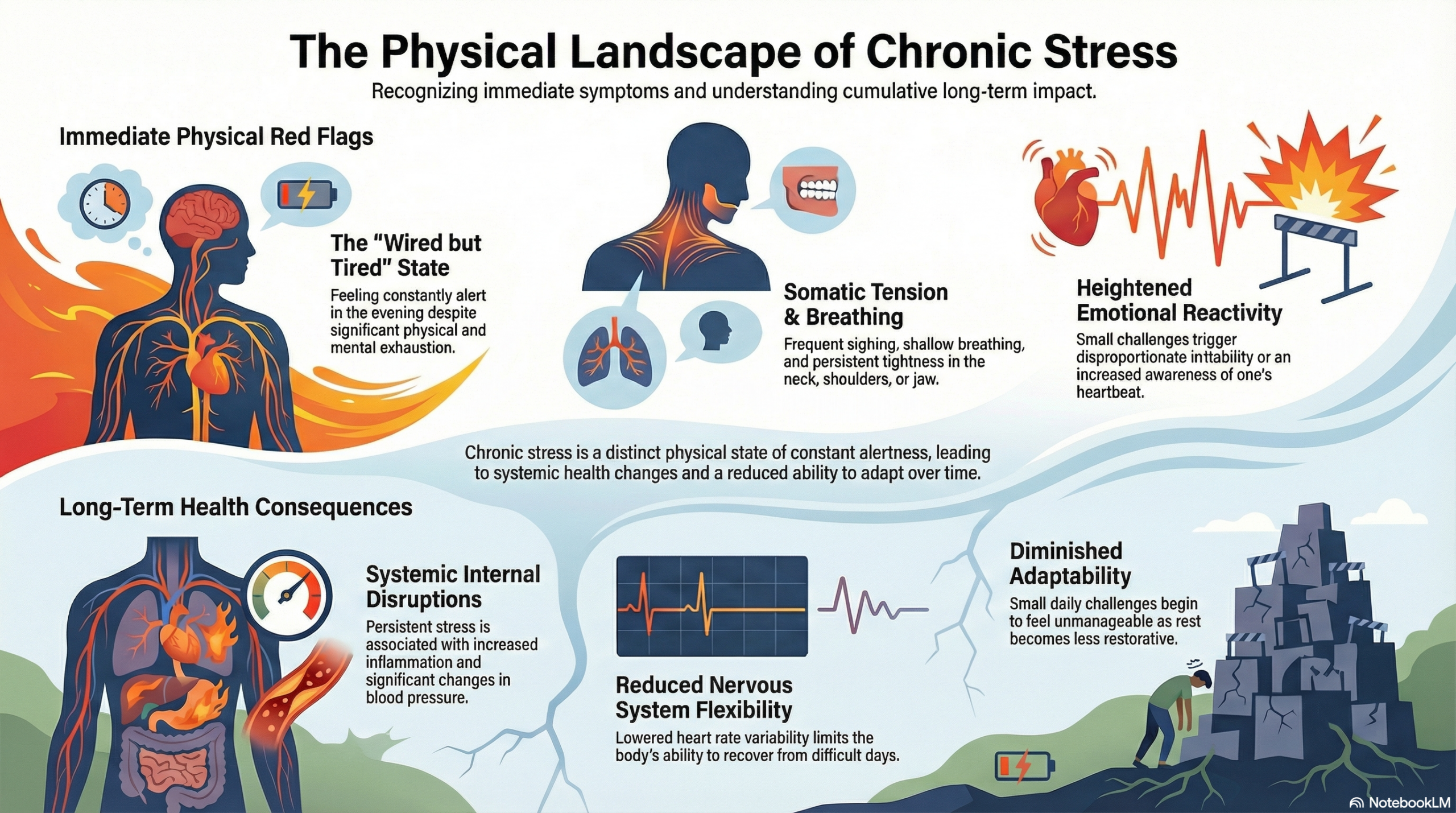
Chronic stress rarely presents as just “feeling busy.” It often shows up physically.
You might notice:
- Difficulty falling or staying asleep
- Waking up already feeling tense
- Frequent sighing or shallow breathing
- Tightness in the neck, shoulders, or jaw
- Increased irritability or emotional reactivity
- Palpitations or heightened awareness of your heartbeat
- Digestive changes, especially during demanding periods
- Feeling “wired but tired” in the evening
Some people describe it as feeling constantly alert, even when there is no immediate problem to solve.
Others notice that they no longer feel fully relaxed — even on vacation.
When Stress Begins to Spill Over
Because stress affects multiple systems at once, it often becomes the umbrella under which other issues develop.
Sleep may become lighter and more fragmented.
Anxiety may feel more pronounced.
Digestive symptoms may become more frequent.
This doesn’t mean something is fundamentally wrong with you. It means your nervous system has been working hard for a long time.
Without recovery, the body does not reset easily.
Long-Term Effects of Unresolved Stress
When stress persists for months or years, the cumulative impact can be significant.
Long-term stress has been associated with:
- Disrupted sleep patterns
- Increased inflammation
- Blood pressure changes
- Impaired digestive function
- Increased vulnerability to mood disturbances
- Reduced heart rate variability (a marker of nervous system flexibility)
More subtly, chronic stress reduces adaptability.
You may find that small challenges feel disproportionately large. Recovery from difficult days takes longer. Rest does not feel as restorative.
This is not a personal weakness. It is physiology.
The Encouraging Part
The nervous system is remarkably adaptable.
Just as it can become conditioned toward constant activation, it can also relearn how to regulate.
The first step is recognizing that what you’re experiencing may be a stress pattern — not a personality flaw, not a lack of discipline, and not something you simply need to “push through.”
If any of the symptoms above feel familiar, it may be helpful to take a structured look at how your system is functioning.
Stress rarely resolves through willpower alone. It improves when the nervous system is supported consistently and intentionally.
If you’re experiencing ongoing stress that is affecting your sleep, digestion, mood, or physical comfort, booking an appointment can be a practical next step. Together, we can assess what may be contributing to the pattern and create a plan to help your body regain stability and resilience.
You don’t have to stay in “on” mode indefinitely.
Getting Help With Drew
If your nervous system has been in overdrive for some time, that does not mean this is your permanent state. Adaptability can be rebuilt. If you’re experiencing ongoing stress, anxiety, insomnia, or stress-related digestive symptoms, I encourage you to book an appointment.
Together, we can evaluate how your system is functioning and create a structured plan to help it regain flexibility and resilience.